
Insights · Building a product · 19 October 2026
Who Signs the Declaration of Conformity for the Radio Inside Your Product?
Two weeks ago we wrote that somebody signs between the prototype and the five hundredth unit, and we promised to come back to it. This is that post. When the radio inside your product was designed by somebody else, the declaration of conformity is still yours, and most teams read that sentence properly far too late.
We write this for whoever is about to design a certified radio module into a product their company will sell. The module looks like a component. In regulatory terms it behaves like an inheritance.
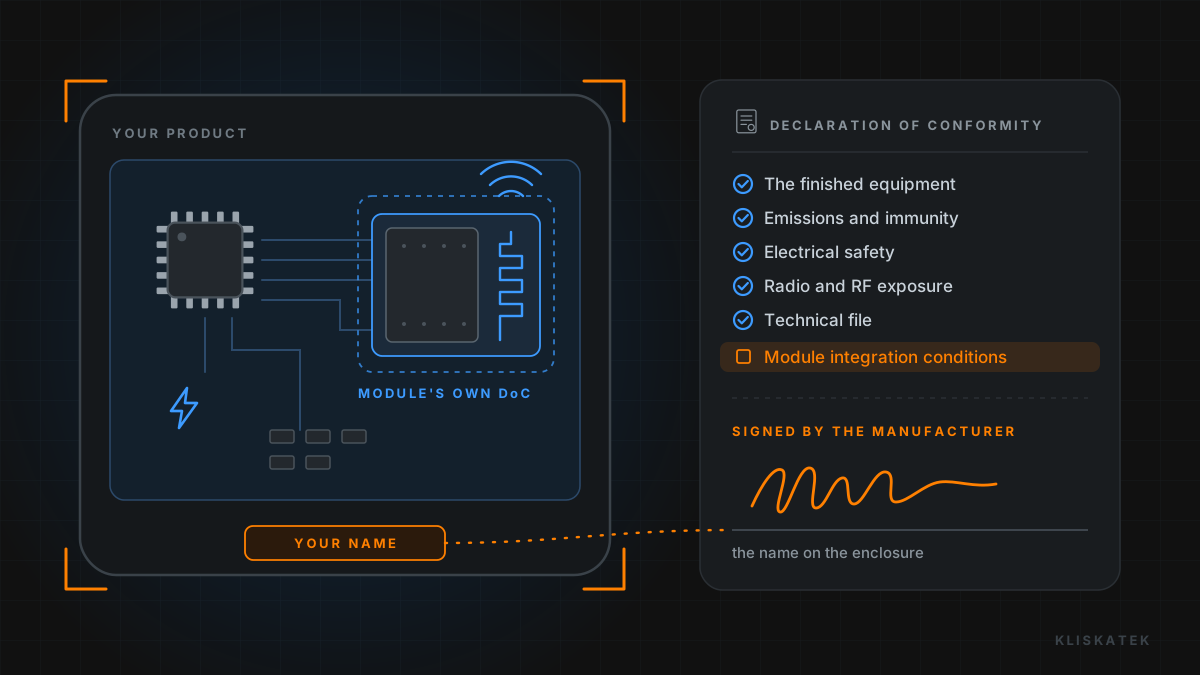
What the module vendor actually hands you
A good module arrives with real paperwork. It carries its own CE mark and its own declaration of conformity. It comes with test reports against the radio standards, a statement about radio frequency exposure, and an integration guide that nobody reads until something fails.
That package is worth money and it saves weeks. It is also the source of the misunderstanding, because none of it is a declaration of conformity for your product.
Europe has no modular approval, so the declaration of conformity is yours
In the United States a transmitter module can hold its own authorisation, and a host product can rely on it under stated conditions. Engineers who have shipped there carry that model in their heads.
Europe does not work that way. There is no modular approval route. Putting a radio module inside an electronic product creates a new piece of radio equipment, and that new product falls under the Radio Equipment Directive on its own account. The only route is a declaration of conformity for the finished equipment, signed by its manufacturer.
The word manufacturer is the trap. It does not mean whoever soldered the board. It means whoever places the product on the market under their name. Design a module in, put your logo on the enclosure, sell it, and you are the manufacturer of a radio product.
What a certified module really saves you
The saving is real, and it is narrower than people expect. The module’s test reports cover the transmitter itself, so the radio measurements and the exposure assessment lean on work somebody already paid for. Pick a module with no certification behind it and that work lands on you.
What the module does not cover is everything your product adds. The module’s declaration of conformity covers the module. Your digital electronics emit, so the electromagnetic compatibility of the whole product gets measured anyway. Immunity gets measured. Electrical safety follows your enclosure, your supply and your intended environment, not the module’s. A certified module reduces the paperwork, not the testing.
European scope is also wider than the North American one. Transmitter performance, receiver performance, emissions, immunity, product safety and radio frequency exposure all sit inside the same assessment. Teams that budget from a United States number are usually short.
The integration conditions are part of your declaration of conformity
The integration guide is not courtesy documentation. It is the set of conditions under which the module’s test results mean anything. Antenna type and maximum gain. Trace layout and ground plane. Minimum separation from the user. Rules about sitting next to another transmitter.
Stay inside those conditions and you can lean on the module’s evidence. Step outside and you are holding test reports for a configuration you did not build. The step outside is rarely dramatic. The antenna moves eight millimetres to clear a screw boss. A metal bezel arrives in revision B. A second radio joins the design because the product needs a local link as well. Each change is sensible on its own, and each one quietly pushes the product out of the envelope the evidence describes.
Two dates that already moved, not two that are coming
Both of these are in force now, which is the part that surprises people.
Since 1 August 2025 the cybersecurity requirements of the Radio Equipment Directive apply, under Delegated Regulation (EU) 2022/30. If your equipment connects to a network, directly or through a phone, those requirements sit inside the assessment behind your declaration of conformity. Whether they apply at all depends on how the product communicates. That is a design question, not a paperwork question.
Since 11 September 2026, article 14 of the Cyber Resilience Act applies: actively exploited vulnerabilities and severe incidents have to be reported. The rest of that regulation applies from 11 December 2027. A product you are designing today will ship into it.
What sits behind a declaration of conformity
The signature is the visible part. Behind it sits a technical file. A description of the product, the schematics and the list of standards applied. The test reports and the risk assessment. The module’s own declaration of conformity, and the evidence that your design respects its integration conditions.
Whoever signs is stating that this file exists and that it is true. That is why the question of who signs is not administrative. It decides who has to be able to answer a question about the product two years after launch, when the person who chose the module has changed jobs.
Where this breaks in practice
Almost never in the laboratory. Nearly always in the calendar.
The pattern repeats. The module gets chosen on price, lead time and reference design. Conformity gets a line in the budget with a round number next to it. The first serious reading of who signs happens after the tooling is paid for, which is the moment when every answer is expensive.
Splitting the project across suppliers makes it worse, and we have written about that seam before. The hardware supplier says the module is certified, and that is true. The mechanical supplier moves the antenna, and that is reasonable. The firmware supplier raises transmit power to fix range, and that works. Nobody lies, nobody is wrong inside their own scope, and the declaration of conformity waits for somebody to notice it has no owner.
There is a version of this that goes well. We described it in a different context: a sensor whose hard part belongs to somebody who already dealt with its conformity. That is the same principle, used on purpose instead of by accident.
Questions worth asking before you design it in
- Who places this product on the market under their name? Write the company down, not a role.
- Which conditions does the module’s integration guide impose, and does the mechanical design respect every one of them today?
- Does the product connect to a network, directly or indirectly?
- Who compiles the technical file, and have they seen the actual product?
- What happens to the evidence if the antenna moves, the enclosure changes or a second transmitter joins?
- Is the module’s own declaration of conformity current, and does it cover the band and the power level you actually use?
If your team can answer all six, the conformity work is an expense you can plan. If two of them produce a pause, it is a risk sitting in your schedule.
Where to start
We do not take that signature off your hands. In a client project the manufacturer is you, and we say so in writing before the work starts. What we can do is keep the design from making that signature harder than it needs to be. Module and antenna chosen together. The integration conditions treated as requirements rather than as documentation. The evidence collected while the decisions are fresh, instead of reconstructed a year later.
If you have a product with somebody else’s radio inside and nobody has written down who signs the declaration of conformity, that is a good subject for a paid scoping study. It is a short piece of work with a document at the end. You can also read how we work across hardware, firmware, software and radio, or last week’s post on monitoring a backup battery without a second battery.
Next week: the change that was too small to re-test, and what eight millimetres do to the evidence behind your signature.